When people hear “wireless communication,” they usually imagine Wi-Fi or Bluetooth—signals spreading widely through space, sometimes slow, sometimes unstable, and often affected by interference.

Nessum Air takes a fundamentally different approach.
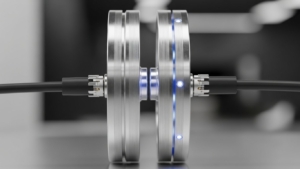
Instead of trying to reach far, it is designed to replace very short Ethernet links—the kind of connections where you would normally use a 100BASE-T cable over tens of centimeters.

By focusing only on communication with the device right next to it, Nessum Air functions as an invisible Ethernet cable, enabling high-speed, reliable, and secure connections, while also allowing many links to be placed densely side by side without interference, all without physical contact.


What Makes Nessum Air Different?

Nessum Air is a short-range wireless technology that behaves much more like a cable than a conventional radio system.

It is designed with a physical layer capable of very high data rates (up to 500 Mbps PHY), allowing two nearby devices to exchange data at high speed without any physical connector. The communication distance is intentionally limited to about 0.5 m and can be adjusted by the size of a small loop antenna.

Unlike Wi-Fi or UWB, which use radiated electromagnetic waves designed to travel far, Nessum Air uses magnetic field coupling.
Magnetic fields decay rapidly with distance and remain tightly confined around the source, which naturally limits how far the signal spreads.

Because of this physical behavior:

  • Signal spread is far smaller than with radiated radio
  • Installation density can be increased by dozens of times
  • Interference between nearby links is minimized
  • Communication remains stable even around metal, dust, oil, or water

In short, Nessum Air trades long-distance reach for precision and stability—exactly what short Ethernet links require.


How Is It Different from Other Wireless Technologies?

Technology Distance Medium Frequency PHY rate
Nessum Air ~0.5m Magnetic field ~56MHz ~500Mbps
NFC ~0.1m Magnetic field 13.56MHz ~0.4Mbps
UWB ~10m Radiated waves 3,100-10,600 MHz ~480Mbps
  • NFC is safe and localized, but far too slow for Ethernet replacement.
  • UWB can be fast, but its radiated signals spread widely, making dense deployment difficult.
  • Nessum Air combines short range with wired-class speed, while keeping signal spread tightly controlled.

What Can You Do with an Invisible Ethernet Cable?

  • A Wear-Free Ethernet Link for Rotating Machines

Rotating machines often rely on slip rings to carry Ethernet or control signals across rotating interfaces. These mechanical contacts wear out, generate noise, and require maintenance.

With Nessum Air, a stationary unit and a rotating unit can exchange Ethernet-class data without touching at all.

There is no mechanical wear, no contact noise, and no connector maintenance—yet control signals and even video data can flow continuously.
In environments exposed to oil, dust, or vibration, Nessum Air provides a practical alternative to conventional slip rings.

  • “Wireless 100BASE-T” Service and Maintenance Connections

In many devices, Ethernet connectors are needed only for setup, diagnostics, or maintenance—but exposing a physical port reduces reliability and sealing.

Nessum Air can act as a temporary, proximity-based Ethernet cable.

By bringing a Nessum Air interface close to a device—much like attaching a magnetic connector—you can access an internal Ethernet port without opening the enclosure.

This is ideal for:

  • Maintenance or service ports not intended for end users
  • Fully sealed or waterproof equipment
  • Systems where exposed connectors are a reliability risk

When you remove it, the Ethernet connection disappears.


  • Modular Systems Without Ethernet Wiring

Nessum Air’s short range and limited signal spread naturally enable modular system design.

Each device behaves as a self-contained module with a short-range Ethernet interface.

When modules are placed side by side, Ethernet traffic passes from one module to the next—without cables, connectors, or manual configuration.

Typical examples include:

  • High-density server racks
  • Automated warehouse storage systems
  • Gaming machines installed in rows
  • Expandable delivery lockers
  • Digital signage and video walls

In these systems, adding or removing modules simply extends or shortens the Ethernet chain, while maintaining high-speed, secure, and interference-free communication.


Conclusion

Nessum Air is not meant to replace Wi-Fi, cellular networks, or long Ethernet cables.

Its purpose is more specific:
to replace short Ethernet links in places where cables cause wear, complexity, or reliability problems.

By combining a high-speed physical layer with tightly confined magnetic-field communication, Nessum Air functions as an invisible Ethernet cable—enabling higher installation density, improved reliability, and simpler system design.

As systems become more compact, sealed, and modular, Nessum Air offers a clear and consistent approach to connectivity:
not by reaching farther, but by replacing short cables more precisely.

Get Started Today

Order your Evaluation Kit and experience the benefits of Nessum today!

About the Author
Kengo Tamukai is a senior engineer specializing in wired and wireless communication technologies. With over 20 years of experience in LSI design, system architecture, and technical marketing, his expertise spans SoC design, OFDM-based technologies, and hybrid communication systems, driving innovation in modern digital networks.

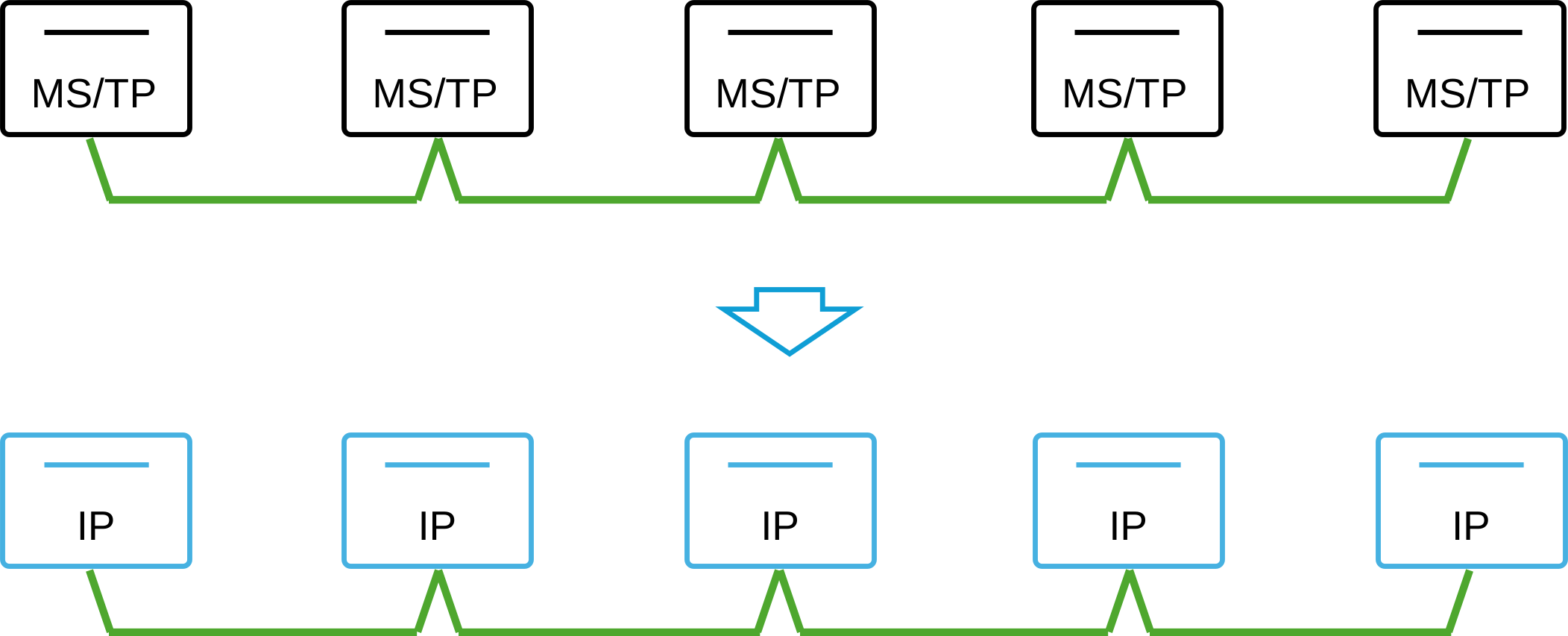
Many devices in existing buildings and facilities still rely on legacy serial communication protocols such as Modbus RTU. At the same time, newly added equipment—including BMS controllers, sensors, AI cameras, and IoT gateways—are typically IP-based. While serial communication wiring is often already installed (frequently routed through conduits or embedded in walls), rewiring for Ethernet is difficult and costly. Furthermore, serial communication has limitations in terms of scalability and transmission speed.

Nessum’s Ethernet and serial bridging functionality offers an effective solution to these challenges, enabling a seamless transition to IP-based networks without abandoning the existing serial infrastructure.


Limitations of Traditional Ethernet Extenders

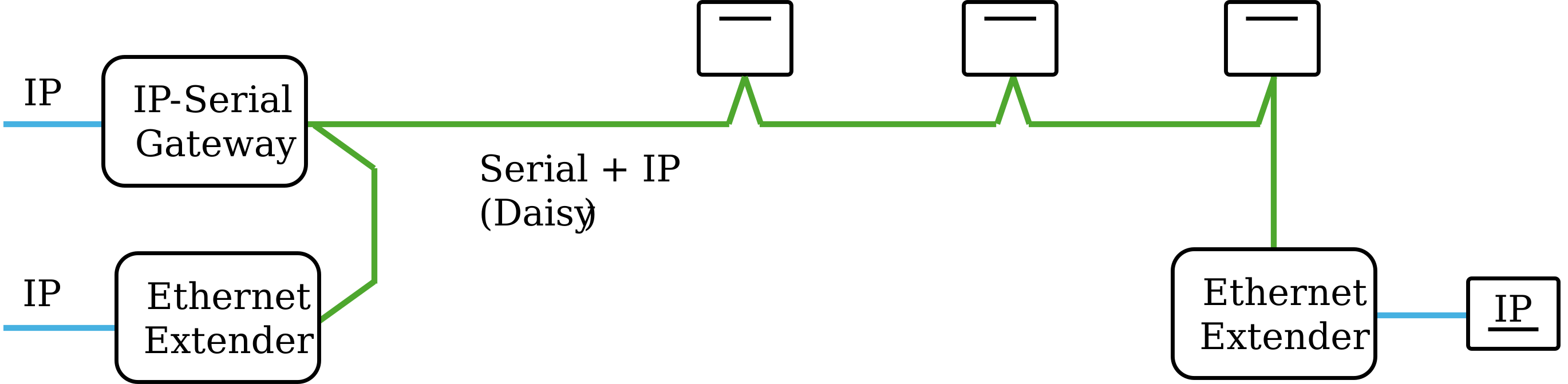
One conventional solution is the Ethernet extender, which transmits high-frequency signals over existing wiring without interfering with ongoing serial communication. However, most Ethernet extenders only support point-to-point connections. This makes them suitable for connecting a single IP device, but not ideal for integrating multiple IP devices over a shared serial cable.


Nessum’s Unique Approach

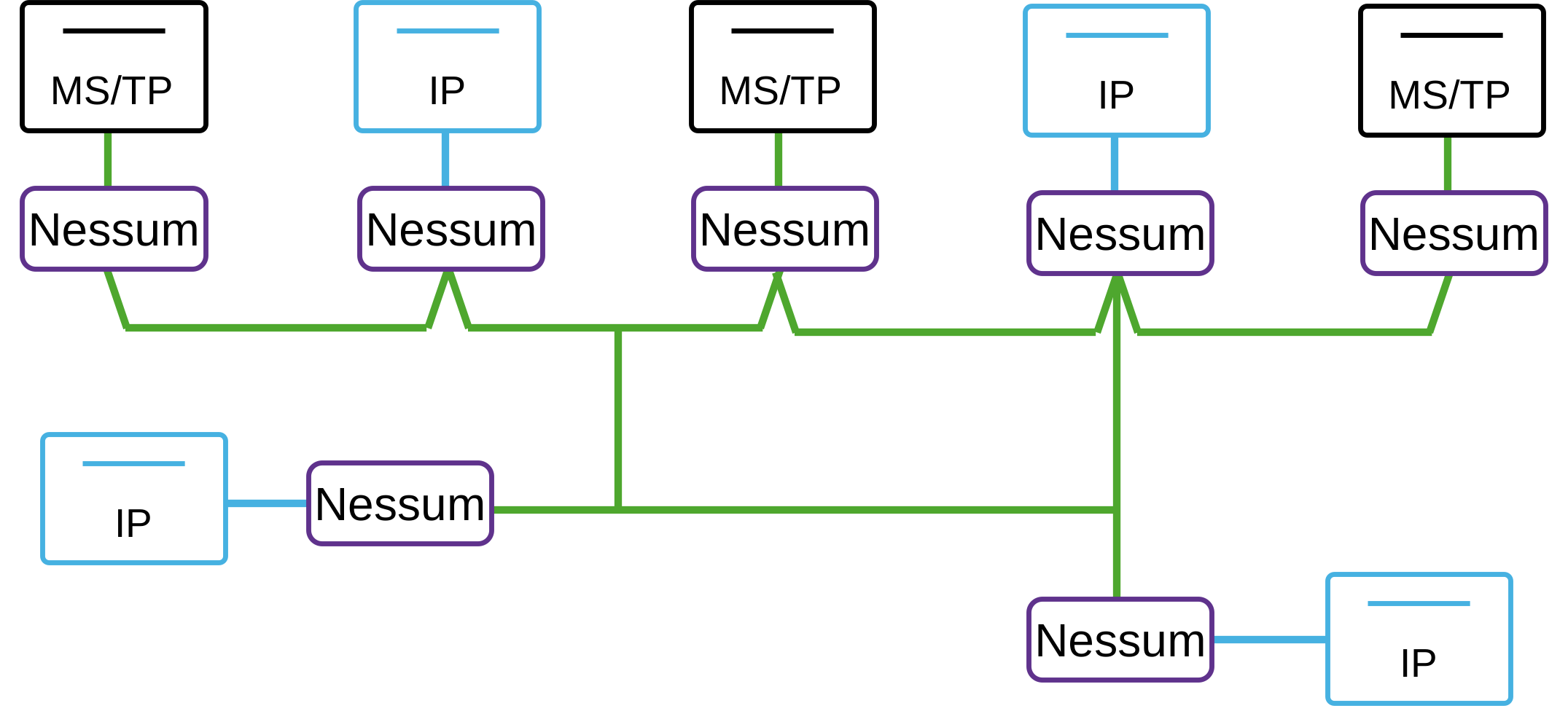
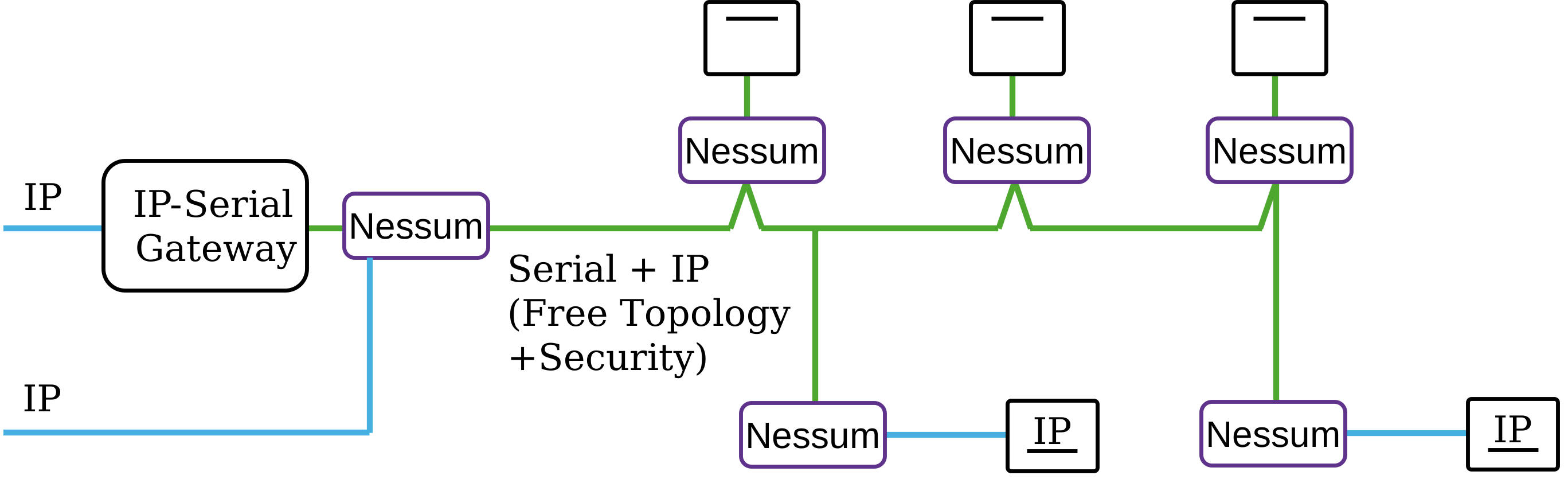
Nessum’s core functionality is Ethernet bridging. The entire Nessum network operates like a Layer 2 (L2) switch, where each Nessum device functions as a port of the switch. When an Ethernet device is connected to a Nessum node, Ethernet packets are automatically bridged across the network—without any configuration—just like a plug-and-play L2 switch.


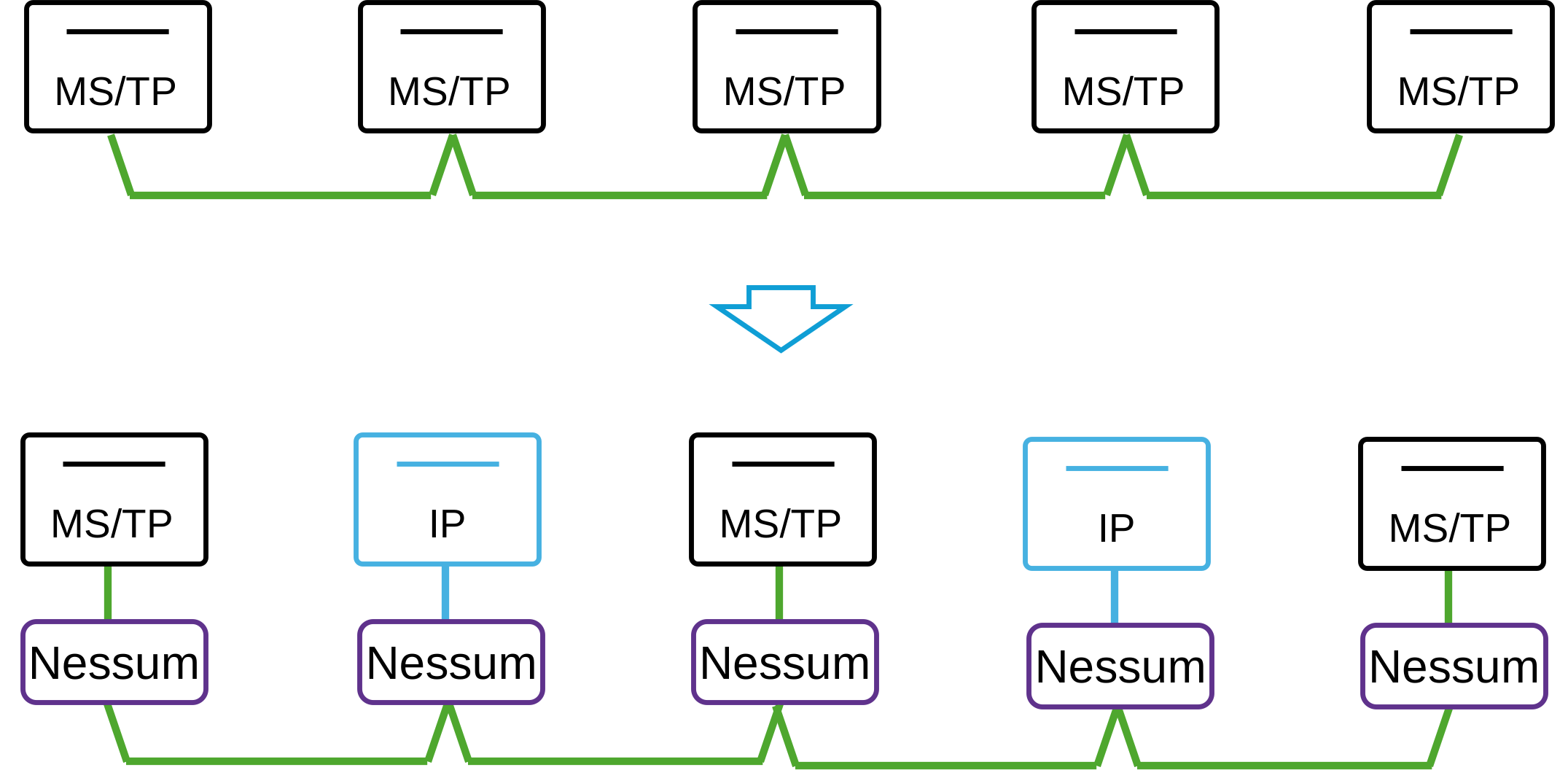
In addition to Ethernet bridging, Nessum also supports serial bridging. Data received on the serial port is encapsulated into Ethernet packets and routed to the appropriate destination address, using the same mechanism as Ethernet bridging. This dual-bridging capability allows serial and IP devices to operate simultaneously over the same physical cable.


From a topology standpoint, Nessum’s multi-hop capability and OFDM-based modulation enable communication over existing serial communication cables—even in free topology. While high-frequency communication (in the MHz range) typically faces challenges like signal reflections and attenuation at cable branches, Nessum is specifically designed to overcome these issues. This makes it highly suitable for retrofitting and expanding networks without the need for new wiring.


By simply attaching Nessum devices to existing serial endpoints, new IP devices can be added alongside legacy serial devices with no service interruption. While there is an initial cost to install Nessum devices, the result is a hybrid architecture that supports gradual, step-by-step migration from serial to IP communication.


To enhance security, Nessum also applies AES-128 encryption to all communications. This significantly improves the protection of serial communication lines, which are typically unencrypted and vulnerable to interception or tampering.


Conclusion

Nessum offers a practical and future-ready solution for bridging legacy serial systems with modern IP networks. Its plug-and-play Ethernet and serial bridging, flexible topology support, and built-in encryption make it ideal for facilities seeking to modernize without the disruption and cost of rewiring. Whether you’re planning a gradual upgrade or preparing for large-scale digital transformation, Nessum provides a reliable and secure migration path from serial to IP.


Get Started Today

Order your Evaluation Kit and experience the benefits of Nessum today!


About the Author
Kengo Tamukai is a senior engineer specializing in wired and wireless communication technologies. With over 20 years of experience in LSI design, system architecture, and technical marketing, his expertise spans SoC design, OFDM-based technologies, and hybrid communication systems, driving innovation in modern digital networks.

If you’ve never heard of Nessum, you’re not alone.
Even though the technology behind it has been around since the early 2000s under the name HD-PLC, it’s still relatively unknown outside of specific industries.
So, the first reaction many people have is:
“Nessum? What’s that supposed to be?”

Here’s the simple answer:
   Nessum is like a networking bridge that lets your devices talk to each other — whether they use Ethernet or old-fashioned serial connections — all over the wires you already have.

Instead of pulling new cables or replacing old equipment, Nessum makes it possible to:

  • Plug in Ethernet devices and connect them instantly
  • Keep using legacy serial devices like sensors or controllers
  • Extend networks across power lines, twisted pairs, or almost any existing wiring

And while the roots of Nessum come from HD-PLC, it has continued to evolve with industrial use in mind — adding flexibility, reliability, and scalability that make it practical for today’s building and factory networks.

In this FAQ, we’ll cover the most common questions to give you a clear picture of what Nessum does and why it matters.


Q1. How is a Nessum network structured?

A Nessum network consists of one Master device and multiple Terminal devices.

Think of the Master as the main point that organizes the network, but devices can also communicate directly with each other. This simple structure allows all connected devices to exchange information reliably over the same wiring, whether it’s twisted pair or other types of existing cables.

Q2. What is the basic function of Nessum?

Nessum works like a plug-and-play bridge.

  • For Ethernet devices: just plug them in, and packets flow as if through a standard Layer 2 (L2) switch.

  • For serial devices: data is encapsulated into Ethernet packets and sent across the network.

Nessum supports Modbus RTU and Modbus ASCII by default, and can also bridge other serial protocols if destination address information is defined.

This dual bridging allows Nessum to connect both modern Ethernet devices and legacy serial equipment seamlessly.

Q3. Is Nessum just another L2 switch?

Not exactly.
While Nessum behaves like an L2 switch from the outside, it isn’t competing with network switches. The big difference is the medium:

  • Nessum can operate over existing power lines, twisted pairs, or almost any wire, and even short-range wireless.

At the same time, Nessum provides many of the same functions as an L2 switch, including:

  • VLAN support for flexible network segmentation
  • MAC address filtering for traffic control and security
  • PTPv2 support for precise time synchronization across devices

This makes it much more than just a simple bridge.

Q4. Is the communication secure?

Yes.
The Master device handles authentication and encryption key distribution. Communication uses AES-128 encryption, with keys dynamically updated to maintain strong security.
This ensures reliability even in industrial or building environments.

Q5. Can multiple Nessum networks be connected together?

Yes.

  • You can directly link multiple Nessum networks using Ethernet cables or through another L2 switch.
  • From the outside, the whole system still behaves just like a standard L2 switch.

This makes expansion straightforward.

Q6. What is Multi-hop, and why does it matter?

Multi-hop allows packets to automatically route across multiple Nessum devices within the same network.

  • Each hop extends the effective communication range.
  • From the outside, it still looks like a simple L2 switch — no extra setup required.

This feature is particularly important for replacing long-distance serial communication. With Multi-hop, Nessum can cover distances far beyond a single Ethernet or serial link, making legacy serial networks realistic to upgrade.

Conclusion

Nessum is not just another switch. It is a unifying bridge that:

  • Extends IP networking over existing wiring
  • Connects both Ethernet and serial devices (with Modbus RTU/ASCII support)
  • Provides key L2 switch features like VLAN, MAC filtering, and PTPv2
  • Ensures secure communication with AES-128 encryption
  • Scales across long distances with Multi-hop

By combining these capabilities, Nessum makes the transition from legacy systems to modern IP networks both practical and cost-effective.


Get Started Today

Order your Evaluation Kit and experience the benefits of Nessum today!


About the Author
Kengo Tamukai is a senior engineer specializing in wired and wireless communication technologies. With over 20 years of experience in LSI design, system architecture, and technical marketing, his expertise spans SoC design, OFDM-based technologies, and hybrid communication systems, driving innovation in modern digital networks.

To achieve microsecond-level time synchronization, PTPv2 (Precision Time Protocol version 2) is one of the most effective approaches. By using Layer 2 (L2) switches that support PTPv2 over CAT5 cables, it is possible to distribute highly accurate time. However, this method is limited by its reliance on a star topology, which tends to increase cable lengths and network complexity.

Moreover, when synchronization is required over distances of several kilometers, optical fiber becomes necessary, significantly increasing infrastructure costs. This makes the approach unsuitable for many IoT applications, where cost, simplicity, and flexibility are critical.

The combination of Nessum and PTPv2 overcomes these challenges.


Nessum with PTPv2: A Flexible and Scalable Solution

Nessum supports PTPv2 as defined in IEEE 1901c. In a Nessum network, the system functions as a boundary clock, with time distributed from a Nessum Master to all connected Terminals.

Unlike traditional PTPv2 deployments, Nessum allows for free topology—such as bus, tree, or ring structures—over a variety of wired media including twisted-pair and power lines. This greatly reduces the need for centralized cabling and optical fiber, lowering costs while enabling long-range synchronization across several kilometers.

This architecture enables accurate time distribution while also providing devices with Nessum’s inherent features: robust signal transmission, high security, and flexible channel functionality.

Additionally, PTPv2’s delay measurement mechanism enables precise estimation of path delays, which can also be used for physical length measurements between devices.


Potential Applications

Monitoring of Large-Scale Infrastructure

For critical infrastructure such as bridges and dams, Nessum enables microsecond-accurate data synchronization across widely dispersed sensors—such as deflection sensors on bridge girders or water level gauges in dam reservoirs. This precision supports early detection of subtle structural deformations or signs of deterioration, contributing to predictive maintenance strategies and more reliable structural health assessments, especially during large-scale natural disasters.

Enhancing Ultrasonic Indoor Positioning

Ultrasonic indoor positioning systems can achieve centimeter-level accuracy, but they rely heavily on microsecond-level synchronization between multiple sensors. Nessum simplifies this requirement by providing microsecond-accurate time synchronization over 1–2 km of copper wiring. This eliminates the need for traditional fiber optics or complex PTP wiring, making it easier to build large-scale ultrasonic sensor networks. The result is a flexible and cost-effective solution for high-precision applications such as AGV navigation in factories, control of precision robotics in delicate operations, and real-time location tracking in medical facilities.

Enhanced Security through Acoustic Monitoring

In factories, large-scale facilities, and public spaces, deploying widely distributed acoustic sensors—such as microphone arrays—synchronized with microsecond-level precision enables highly accurate localization of abnormal sounds, including gunshots, screams, or breaking glass. This enables real-time, wide-area surveillance that conventional systems struggle to achieve, supporting swift initial responses and effective evidence preservation during incidents or emergencies, thereby significantly enhancing overall security.

Timestamped Event Monitoring in Smart Grids

In smart grid systems, which increasingly integrate distributed energy resources like solar and wind power, accurately timestamping events from smart meters, circuit breakers, and power quality sensors down to the microsecond level is essential. Such synchronization ensures grid stability, facilitates rapid fault analysis, and improves the efficiency of energy exchange. Given the wide geographic distribution of power infrastructure, Nessum’s ability to provide long-range, high-precision synchronization over copper wiring is particularly valuable.

High-Precision Time Synchronization for Building and Facility Emergency Response

In buildings and large facilities, emergency systems such as ventilation fans, lighting, emergency doors, and fire alarms must operate in a coordinated manner during incidents like fires. Microsecond-level time synchronization ensures these systems activate without delay and at optimal timing, enabling accurate monitoring of smoke propagation and the establishment of safe and rapid evacuation routes. This level of coordination is essential for protecting both lives and assets, with its importance increasing proportionally to facility size.

Synchronization of Train and Railway Signaling Infrastructure

In railway infrastructure, where safety and timing are paramount, microsecond-level time synchronization is critical for operations such as signal control, level crossing management, and train position detection. Nessum provides a compelling solution for these applications, particularly in areas where installing optical fiber is physically or economically challenging. By leveraging existing copper wiring, operators can enhance both safety and operational efficiency without large-scale infrastructure overhauls.

Immersive Experience Synchronization in Entertainment Venues

In large-scale entertainment venues—such as outdoor arenas, multi-zone facilities spanning over a kilometer, and expansive theme parks—microsecond-level synchronization of audio systems, large video displays, lighting, and special effects eliminates perceptible delays between sound and visuals. This enables seamless coordination of all sensory elements, delivering a continuous and highly immersive storytelling experience that enhances audience engagement and elevates overall visitor satisfaction.


Unlocking New Possibilities

The combination of PTPv2 and Nessum removes the traditional limitations of time-synchronized applications.

By enabling microsecond-level synchronization over long distances and various wiring infrastructures—including twisted-pair, coaxial cables, and even power lines—this solution addresses the cost, complexity, and topology constraints that have hindered traditional deployments. It opens the door to a wide array of time-sensitive applications in sectors ranging from infrastructure monitoring and industrial automation to transportation, energy, and entertainment.

With its flexibility, scalability, and robustness, Nessum with PTPv2 is poised to become a core enabler of next-generation synchronized systems, allowing engineers and developers to reimagine what’s possible in connected environments.


Get Started Today

Order your Evaluation Kit and experience the benefits of Nessum today!


About the Author
Kengo Tamukai is a senior engineer specializing in wired and wireless communication technologies. With over 20 years of experience in LSI design, system architecture, and technical marketing, his expertise spans SoC design, OFDM-based technologies, and hybrid communication systems, driving innovation in modern digital networks.

Power Line Communication (PLC) sounds like a dream: transforming your existing electrical wiring into a data network, saving you the cost and mess of new cables. It’s a brilliant concept with huge potential.

But in real-world situations, PLC doesn’t always work smoothly. There are several issues that can block or weaken the signal. If you don’t pay attention to these, your connection might be slow, unstable, or fail completely.

Here are five important challenges to watch out for when using PLC.


1. Signal Fade-Out Over Long Cable Runs

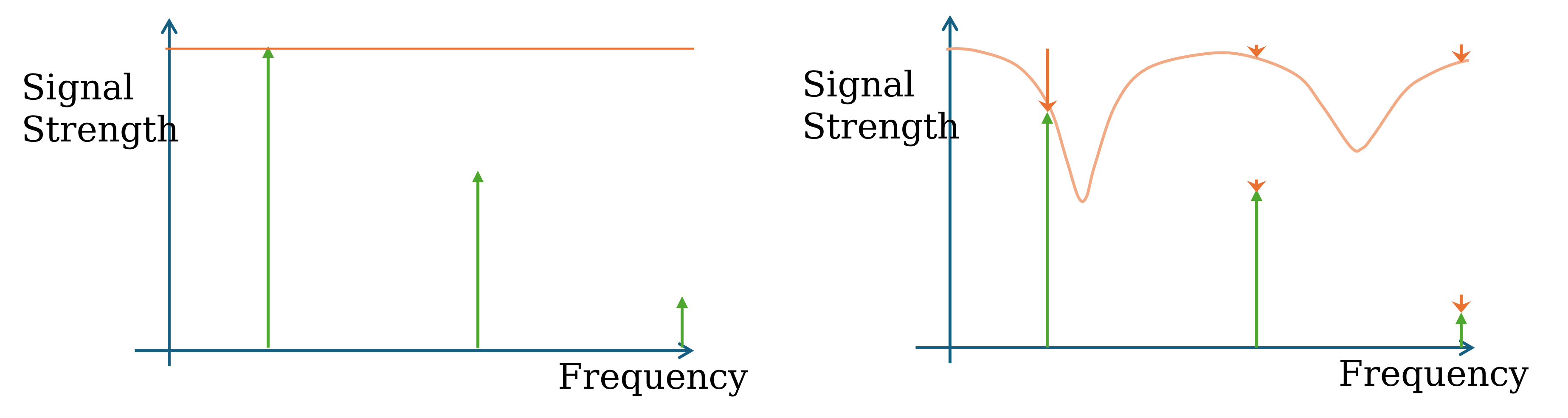
Even though power cables carry electricity well, they’re not perfect for carrying high-speed data signals. Over long distances—especially at the high frequencies used by PLC—the signal gradually fades. It’s like a voice getting quieter the farther it travels.

This signal fading depends on the cable material, the length of the cable and the frequency being used. As a rough guide:

  • Over 100 meters, the signal may drop to about one-tenth (1/10) of its original strength.
  • Over 400 meters, the signal may drop to about one-thousandth (1/1,000).

This kind of loss usually isn’t noticeable in homes, but it becomes important in large buildings like factories or offices with long wiring.


What you can do:

  • Home use: Most homes don’t have cable runs longer than 100 meters, so the signal stays strong enough for PLC to work well.
  • Industrial use: In large facilities with long wiring, using lower-frequency PLC is recommended. Some PLC systems like Nessum support long-distance communication by adjusting the frequency.

2. Too Many Paths for the Signal (Branch Splitting)

Your power wiring usually splits into many branches—especially at the breaker box. This is where the signal can get lost or bounced around.

At low frequencies (like normal electricity), this isn’t a big deal. But at the high frequencies used by PLC, each branch splits the signal more and more—like shining a flashlight through lots of mirrors. The more branches there are, the more the signal gets scattered and weakened.

In the worst case, each branch can reduce the signal by half, and if there are multiple branches in a row, the loss becomes exponential: With 20 branches, depending on the spacing between them, the loss can range from 1/20 to 1/1,000,000.

Note: This simplified estimate does not account for additional signal reflections from impedance mismatches.

What you can do:

  • Home use: Most homes have up to 10 branches, and because the branches are spaced closely together, the signal loss is usually minimal and not a problem for modern PLC devices.
  • Industrial use: In buildings with many and widely spaced branches, it’s a good idea to install signal repeaters (devices that boost the signal) in each breaker box.

3. Devices That Absorb Your Signal (Low Impedance Loads)

Most appliances and electronic devices (like TVs, washing machines, or PCs) are designed to reduce noise, which is good for safety—but not so good for PLC. These devices often include special parts (called X-capacitors) that “absorb” high-frequency signals like those used by PLC. As a result, communication signals are weakened to about 1/100 to 1/1,000.


Also, because these signals travel at high frequencies, even a short distance (like 30–50 cm) between the device and the outlet can change how much the signal is affected.

What you can do:

  • Home use: Try using a short power extension cord (1 meter or so) between the outlet and your noisy device. It often improves the signal.
  • Industrial use: Avoid plugging unknown or unfiltered machines into the same power line as your PLC device. You can also install special parts (like coils) to help keep the signal strong.

4. Noise from Electrical Equipment

Some devices, especially those with motors (like hair dryers or factory machines), create a lot of electrical “noise” that spreads into the power lines. This noise can interfere with the PLC signal, like trying to talk in a room full of shouting people.

Even advanced PLC systems can struggle with noise.

For example, Nessum is capable of maintaining communication even when the signal strength is reduced to less than one ten-billionth (1/10,000,000,000) of its original level. However, when strong noise is present, this high sensitivity can’t be fully utilized, and communication may still fail.

What you can do:

  • Home use: Use noise filters (small plug-in devices) to reduce interference.
  • Industrial use: Install EMC filters to separate noisy machines from your communication lines.

5. Transformers – The Signal Can’t Cross Them

Large buildings often use transformers to change high-voltage electricity into a lower voltage for regular use. Unfortunately, PLC signals can’t pass through transformers easily. It’s like trying to speak through a thick wall—most of the sound gets blocked.


What you can do:

  • Home use: This usually isn’t a problem—homes rarely have transformers inside.
  • Industrial use: Use wireless bridges (like Wi-Fi or specific PLC wireless products such as Nessum-Air) to send signals across different parts of the building.

Conclusion

PLC is a great way to turn your power outlets into network ports without installing new cables. But it’s not plug-and-play in every situation. Real-world environments—especially in industrial or complex buildings—introduce challenges like signal loss, noise, and electrical interference.

The good news:
If you understand and plan for these 5 key challenges, you can enjoy fast and stable PLC communication both at home and in large facilities.


About the Author
Kengo Tamukai is a senior engineer specializing in wired and wireless communication technologies. With over 20 years of experience in LSI design, system architecture, and technical marketing, his expertise spans SoC design, OFDM-based technologies, and hybrid communication systems, driving innovation in modern digital networks.