
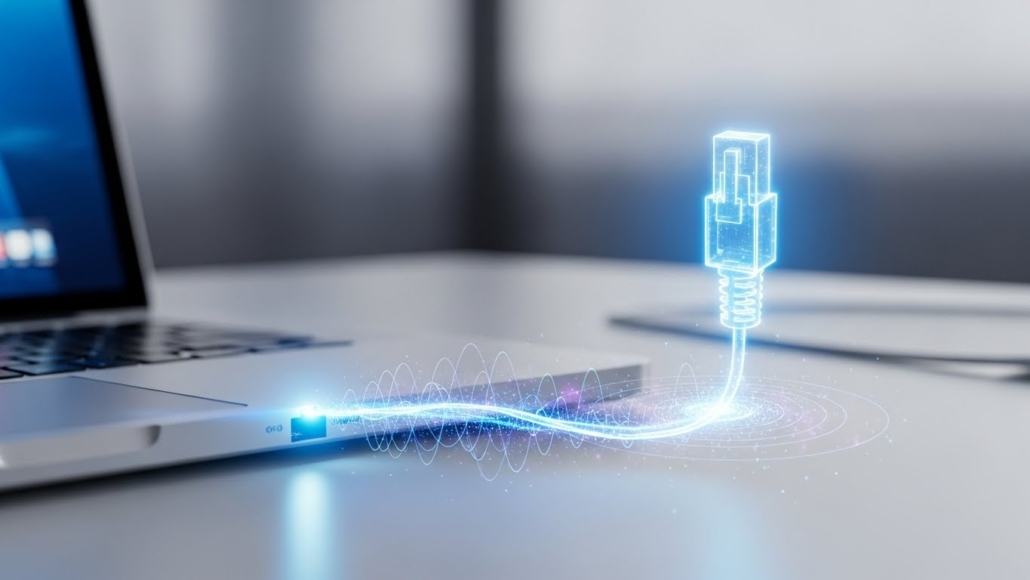
The Invisible Ethernet Cable – Replacing Short Ethernet Links with Nessum Air
When people hear “wireless communication,” they usually imagine Wi-Fi or Bluetooth—signals spreading widely through space, sometimes slow, sometimes unstable, and often affected by interference.
Nessum Air takes a fundamentally different approach.
Instead of trying to reach far, it is designed to replace very short Ethernet links—the kind of connections where you would normally use a 100BASE-T cable over tens of centimeters.
By focusing only on communication with the device right next to it, Nessum Air functions as an invisible Ethernet cable, enabling high-speed, reliable, and secure connections, while also allowing many links to be placed densely side by side without interference, all without physical contact.
What Makes Nessum Air Different?
Nessum Air is a short-range wireless technology that behaves much more like a cable than a conventional radio system.
It is designed with a physical layer capable of very high data rates (up to 500 Mbps PHY), allowing two nearby devices to exchange data at high speed without any physical connector. The communication distance is intentionally limited to about 0.5 m and can be adjusted by the size of a small loop antenna.
Unlike Wi-Fi or UWB, which use radiated electromagnetic waves designed to travel far, Nessum Air uses magnetic field coupling.
Magnetic fields decay rapidly with distance and remain tightly confined around the source, which naturally limits how far the signal spreads.
Because of this physical behavior:
- Signal spread is far smaller than with radiated radio
- Installation density can be increased by dozens of times
- Interference between nearby links is minimized
- Communication remains stable even around metal, dust, oil, or water
In short, Nessum Air trades long-distance reach for precision and stability—exactly what short Ethernet links require.
How Is It Different from Other Wireless Technologies?
| Technology | Distance | Medium | Frequency | PHY rate |
| Nessum Air | ~0.5m | Magnetic field | ~56MHz | ~500Mbps |
| NFC | ~0.1m | Magnetic field | 13.56MHz | ~0.4Mbps |
| UWB | ~10m | Radiated waves | 3,100-10,600 MHz | ~480Mbps |
- NFC is safe and localized, but far too slow for Ethernet replacement.
- UWB can be fast, but its radiated signals spread widely, making dense deployment difficult.
- Nessum Air combines short range with wired-class speed, while keeping signal spread tightly controlled.
What Can You Do with an Invisible Ethernet Cable?
- A Wear-Free Ethernet Link for Rotating Machines
Rotating machines often rely on slip rings to carry Ethernet or control signals across rotating interfaces. These mechanical contacts wear out, generate noise, and require maintenance.
With Nessum Air, a stationary unit and a rotating unit can exchange Ethernet-class data without touching at all.
There is no mechanical wear, no contact noise, and no connector maintenance—yet control signals and even video data can flow continuously.
In environments exposed to oil, dust, or vibration, Nessum Air provides a practical alternative to conventional slip rings.
- “Wireless 100BASE-T” Service and Maintenance Connections

In many devices, Ethernet connectors are needed only for setup, diagnostics, or maintenance—but exposing a physical port reduces reliability and sealing.
Nessum Air can act as a temporary, proximity-based Ethernet cable.
By bringing a Nessum Air interface close to a device—much like attaching a magnetic connector—you can access an internal Ethernet port without opening the enclosure.
This is ideal for:
- Maintenance or service ports not intended for end users
- Fully sealed or waterproof equipment
- Systems where exposed connectors are a reliability risk
When you remove it, the Ethernet connection disappears.
- Modular Systems Without Ethernet Wiring

Nessum Air’s short range and limited signal spread naturally enable modular system design.
Each device behaves as a self-contained module with a short-range Ethernet interface.
When modules are placed side by side, Ethernet traffic passes from one module to the next—without cables, connectors, or manual configuration.
Typical examples include:
- High-density server racks
- Automated warehouse storage systems
- Gaming machines installed in rows
- Expandable delivery lockers
- Digital signage and video walls
In these systems, adding or removing modules simply extends or shortens the Ethernet chain, while maintaining high-speed, secure, and interference-free communication.
Conclusion
Nessum Air is not meant to replace Wi-Fi, cellular networks, or long Ethernet cables.
Its purpose is more specific:
to replace short Ethernet links in places where cables cause wear, complexity, or reliability problems.
By combining a high-speed physical layer with tightly confined magnetic-field communication, Nessum Air functions as an invisible Ethernet cable—enabling higher installation density, improved reliability, and simpler system design.
As systems become more compact, sealed, and modular, Nessum Air offers a clear and consistent approach to connectivity:
not by reaching farther, but by replacing short cables more precisely.
Get Started Today
Order your Evaluation Kit and experience the benefits of Nessum today!
About the Author
Kengo Tamukai is a senior engineer specializing in wired and wireless communication technologies. With over 20 years of experience in LSI design, system architecture, and technical marketing, his expertise spans SoC design, OFDM-based technologies, and hybrid communication systems, driving innovation in modern digital networks.


