

What Is Free Topology? Why It Is Difficult to Implement in Real-World Networks
Free topology allows flexible wiring without strict endpoint constraints, making it ideal for real-world installations.
Free topology has many benefits:
- No need to identify or manage cable endpoints, unlike daisy-chain topology

- Easy to extend from any point, simplifying layout changes

- Minimizing total cable length, Reducing installation and wiring cost

- Support for loop connections, enabling redundancy

However, only a few technologies can handle it robustly and at scale.
Why is free topology difficult?
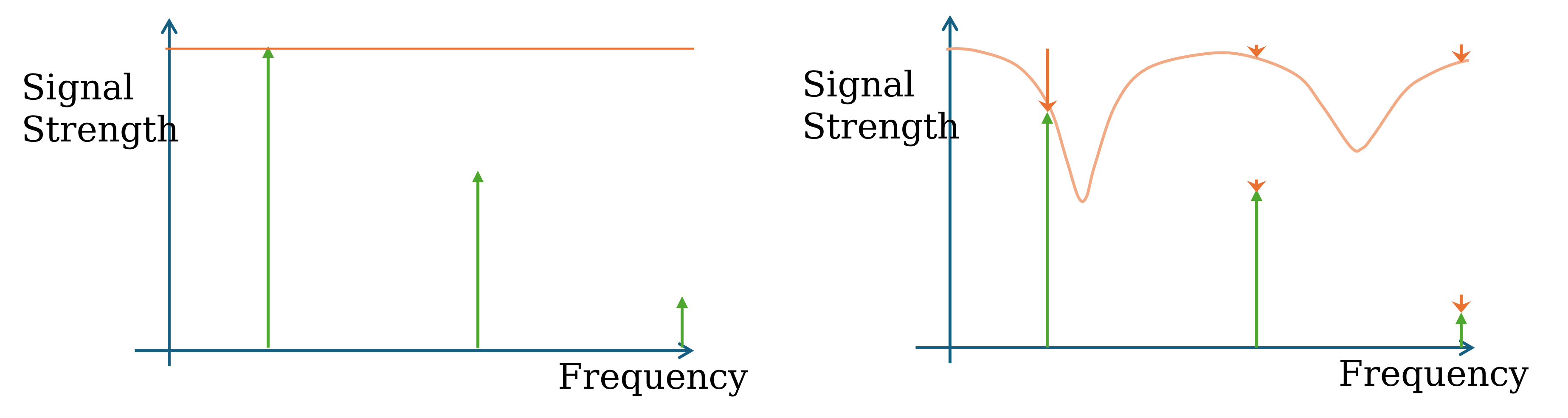
In a free topology network, branches can exist at any point. These branches create impedance mismatches and signal reflections, resulting in frequency-dependent fading (multi-path fading).

A square wave consists of a fundamental frequency and its odd harmonics. When reflections occur, some harmonics are attenuated or canceled, distorting the waveform. This distortion can lead to communication errors.
Which communication technologies can handle this?
Several technologies can handle free topology, with different characteristics:
- Low-speed RS-485 (~9.6 kbps)
- Narrowband PLC (~100–500 kbps)
- Broadband PLC (several Mbps to tens of Mbps)
Low-speed RS-485 can tolerate free topology in practice because its signal spectrum is concentrated at low frequencies, making it less sensitive to reflection-induced notches.
In multi-path environments, shorter branch lengths shift the first notch to higher frequencies. For example, a 500 m branch creates the first notch at around 70 kHz. This is sufficiently higher than the 24 kHz 5th harmonic at 9.6kbps, so low-speed RS-485 is not significantly affected. However, higher data rate signals extend into higher frequencies, where they may overlap with the notch and experience distortion.

PLC (Power Line Communication) is inherently suited for free topology networks. The most widely used PLC modulation scheme is OFDM. OFDM divides data across multiple carriers. Even if some carriers are attenuated by notches, communication can continue using the remaining carriers. This makes OFDM highly robust against the frequency-selective fading caused by free topology.

High-Speed Communication in Free Topology: Challenges and Solutions
While low-speed RS-485 works well for simple control signals, its data rate is limited, making it difficult to support modern requirements such as IP-based communication.
Narrowband PLC improves data rates but still has limitations for bandwidth-intensive applications.
Broadband PLC enables significantly higher data rates, making it suitable for modern networks. However, at higher frequencies, not only reflections but also attenuation due to branch splitting becomes significant.
At lower frequencies, 10 branches may behave roughly like 1/10 attenuation. At higher frequencies, attenuation can increase more rapidly, in some cases approaching exponential behavior (e.g., around 1/2¹⁰ ≈ 1/1024).

To overcome this, multi-hop technology can be used. Multi-hop divides a long, highly attenuated path into multiple shorter links, each with manageable loss. Each node relays the signal, enabling reliable communication over longer distances even under severe attenuation.

Conclusion: Upgrading Free Topology Networks in Real Deployments
Free topology offers significant advantages in real-world installations, especially in buildings, factories, and infrastructure where flexible wiring and future expansion are required.
Broadband PLC combined with multi-hop technology has emerged as a practical candidate to replace legacy low-speed RS-485 networks in such environments. It enables higher data rates while maintaining reliable communication over complex free topology wiring.
One example is Nessum, a Broadband PLC technology that incorporates multi-hop capability. It is already being adopted in real deployments to replace 9.6 kbps RS-485 systems, enabling modern high-speed IP-based communication over existing wiring infrastructure.
Get Started Today
Order your Evaluation Kit and experience the benefits of Nessum today!
About the Author
Kengo Tamukai is a senior engineer specializing in wired and wireless communication technologies. With over 20 years of experience in LSI design, system architecture, and technical marketing, his expertise spans SoC design, OFDM-based technologies, and hybrid communication systems, driving innovation in modern digital networks.


